
Bridging Partnership
Breakthrough interview extended reality training towards reducing the autism employment gap (BRIDGING)
A study led by the University of Plymouth, supported by the National Autistic Society.
Introduction
This project explores the use of Virtual Reality (VR) training to support autistic people in finding and maintaining work, with a view to reduce the autism employment gap. VR scenarios will be piloted to help autistic people experience job interviews in a safe and adaptable environment and for employers to understand the vital importance of reasonable adjustments.
Project aims
The overall aim of the project is to create a VR package that helps autistic people overcome interview and work-related anxieties by introducing scenarios they are likely to experience, so they may practice responses whilst controlling their environment.
- To understand the main causes of anxiety and stress around employment.
- To produce a set of VR scenarios and training materials.
- To gather feedback on the VR package.
- To let employers understand how to improve their practises.
Why is this research important?
In the UK, many autistic people are unable to work. Autistic people have reported that job interviews and the first few days at work are difficult, and face-to-face interviews in a new place can make them anxious. The workplace includes situations and environments that can be upsetting. These things can make it difficult to do well in an interview, and also make a job too stressful to keep.
VR scenarios can help autistic people practice job interviews or being at work, build confidence, and find strategies that work for them. This will help them know what to expect, be less anxious, and increase their chances of getting and keeping jobs.
This project addresses an important gap in research and works towards improving employment experiences for autistic people. The study strongly links with our Moonshot Vision towards a society that works for autistic people, specifically its ambition to create inclusive employment environments and opportunities that have autistic people’s needs recognised and supported appropriately.
How is the research being carried out?
Throughout the project, the researchers are working closely with an advisory panel of autistic people and us, the National autistic Society, to make sure the research reflects lived experiences and priorities.
There are three stages to this project:
1. Review past research
The researchers began the project with a realist review to better understand the challenges in early employment experiences in order to address them in the VR package. They did this by gathering evidence from academic papers and lived experiences from autistic people and professionals.
2. Create the VR package and training materials
Next, one of the collaborators, i3 Simulations, led on the creation of the virtual scenarios. A VR headset with eye tracking and heart rate sensors will be used to measure user’s responses to the training scenarios (i.e., attention focus, anxiety). This will allow the researchers to adapt the scenarios to better suit the needs of autistic people.
The co-production group, made up of autistic people and employability experts, will co-create VR scenarios and a training package for those helping autistic people into work.
3. Gather feedback about the VR package
Finally, the researchers will ask autistic people to test the VR scenarios and gather feedback. This feedback will help the researchers improve and finalise the VR package and training materials for a bigger future study.
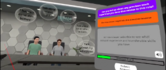
Interview screen of VR package
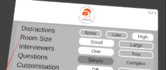
Start menu of VR package
Meet the research team
-
Michael Louizou (Principal Investigator) is an Associate Professor at the University of Plymouth. He has experience in VR for healthcare and wellbeing.
- Peter Langdon (Investigator) is a Professor at University of Birmingham. His work focuses on people with intellectual and developmental disabilities, and testing complex health interventions.
The wider project team includes collaborators from Coventry University, University of the West of England: Bristol, University of Warwick, Bristol, North Somerset and South Gloucestershire NHS, Coventry and Warwickshire Partnership NHS Trust, i3 Simulations, Wolfram, Kimel Foundation, and ourselves.
How is the NAS involved in this project?
Our charity is helping to ensure autistic people’s voices and experiences shape the work from start to finish. We brought together an advisory group of five autistic people from a diverse range of employment experience. The group meet with the research team periodically sharing their insights and guiding each stage of the work.
We also contribute to regular project team discussion, review key documents, and will share project updates and findings.
Who is funding the project?
How long will this project take?
This project is taking place over three years from June 2023 to May 2026.
Where can I find out more about this project?

Employment
Here you'll find advice for autistic people on looking for a job, as well as information for autistic people in work.
Employment