
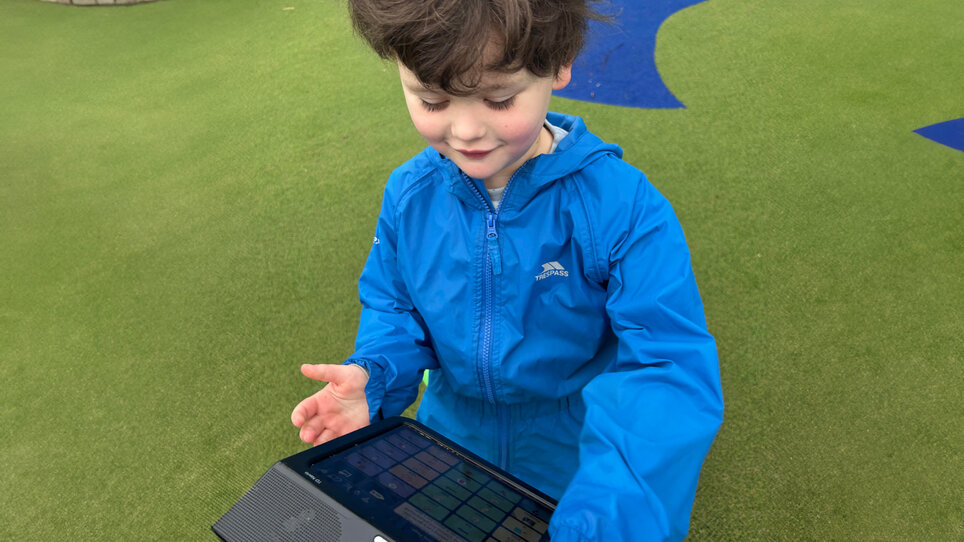
"Ethan is non-speaking and uses his AAC device to communicate his needs, share his favourite things and demonstrate his sense of humour."
Laura, Ethan's mum
Introducing Ethan to AAC
Laura writes about how her family got started with an Augmentative and Alternative Communication (AAC) device for their son Ethan – plus, a few important things they’ve learned along the way.
Introducing an AAC device to our non-speaking, autistic five-year-old Ethan has been hands down the best thing we’ve ever done for our family. It’s been life-changing for Ethan. He can now communicate his food and activity requests, tell us when he’s poorly and advocate for himself in situations that he may find overwhelming. He’s been known to press buttons such as ‘finished’, ‘home’ and ‘let’s go to the car’ to communicate his needs to us, and that he is struggling in that specific situation, which is just incredible.
But Ethan’s AAC has also been life-changing for us as his parents. We can finally serve up a meal or do an activity we 100% know our child wants. We get a wonderful insight into his mind by watching in awe as he navigates his device, and we feel more confident sending him off to his specialist school, knowing he can communicate his needs.
How we got started
When Ethan was as young as two years old, I always imagined him using an AAC device in his future; he’s a whizz with technology. He’s always had a desire to communicate his needs, such as with hand-leading, and he has clear likes and dislikes that he would share with us via non-verbal communication. His strong desire to communicate was something we were keen to harness, and we wanted to make robust communication a reality in his life as soon as possible. Robust communication means that Ethan can be understood by everyone and he has access to a huge amount of language that can grow and adapt with him as he gets older.
We wondered if Ethan’s short attention span and high sensory-seeking nature – meaning he rarely sits still – would hold us back, but I’ve since learned there are no prerequisites for introducing AAC. I can almost guarantee any negative comment or myth you may have heard about AAC is totally untrue, such as the device will stop a child speaking or they must have certain skills before they can use it.
When it came to introducing an AAC device, we found the right time for Ethan and our family (this is important, as it’s definitely a whole family commitment), and we’ve now been using his AAC device for almost a year. It’s firmly part of our world. We take it everywhere we go. Modelling on the device feels totally natural for all of us, and we would be totally lost without it.
We are now lucky enough to be using an in-built AAC device called the TD Navio, which uses the TD Snap App. But to get started, we cracked on ourselves. We were kindly given an old iPad from Ethan’s grandma. We downloaded the TD Snap App and – hey presto – we had an AAC device. That’s another myth to bust; you absolutely don’t need to wait for anyone to give you permission to begin AAC. A child is never too young. The child doesn’t need to prove anything, and you can get started yourself with an iPad and an AAC app.
One decision we made early, which has been really beneficial to us, was to keep Ethan’s AAC iPad purely for communication. We call it Ethan’s talker, and from day one, this was all it was used for – no YouTube, no games (we watched and played elsewhere, of course, but this iPad was just for communication). Within TD Snap, we use the Motor Plan 30 page set, which means that each word appears only once on the device with a distinct path to find it, which can be memorised – this is what suits Ethan best.
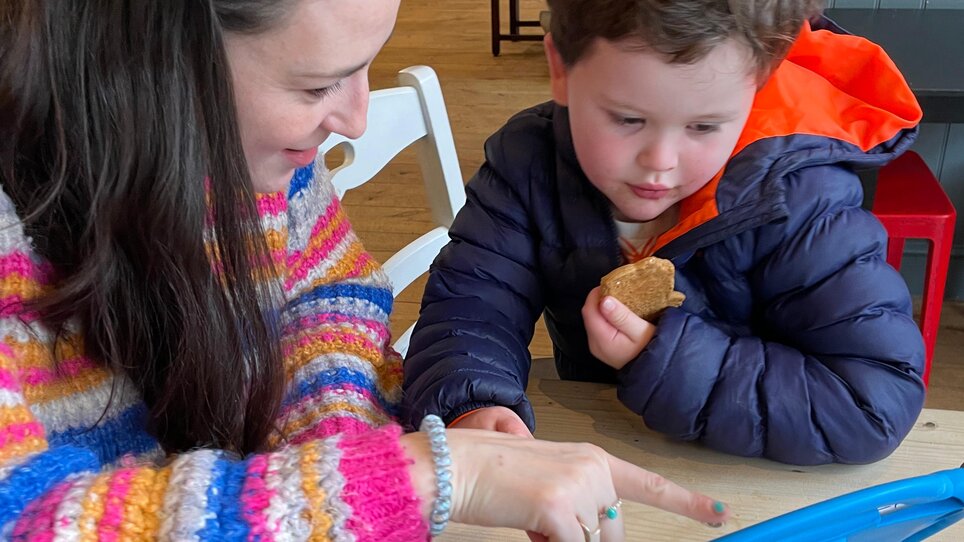
Here are a few things we’ve learned on our AAC journey:
- Get used to taking the AAC device everywhere you go and, at first, just make this your only goal. Make the device part of your family – buy an iPad strap to wear it, buy a case with a stand, and make sure it’s always charged and ready to go.
- AAC is a joint family effort. It’s your job to model, model, model as much as possible. It’s a new language to learn, so make sure you’re in the right place mentally before taking on this task. It’s okay to delay until the time is right for all of you.
- Start first by modelling highly motivating items, such as favourite food and activities. Don’t expect instant success – keep going, keep modelling, keep connecting. During lunchtime, you could model by pressing the buttons for the food they are eating alongside descriptors such as ‘I’m hungry’, ‘hot’ or ‘yummy’.
- AAC is your child’s voice – it’s not just for requesting. It’s a chance for all communication – let them babble via the device (repeatedly hitting the same word), hit all the buttons and have fun with it. Don’t make it a chore or a demand. A no-pressure approach, while celebrating all wins, has worked well for us. Make it fun, make it exciting, and make it a wonderful way to connect with your child.
- It’s your child’s device! Let them use it, drag it around, have it while eating, use it while playing – hence the sturdy case! It needs to be accessible at all times.
- Personalise the device to include your child’s favourite things, from food, to family pets and favourite phrases. This is so important to keep it fun. You can also personalise the buttons with photos of the particular item, venue or activity if you think your child would respond to this better.
- Keep the AAC device as it is in terms of all the language and words available – don’t be tempted to simplify the device or delete words and buttons. Presume competence always. The more language they see, the more language they will use.
Lastly, here are a few important AAC statements for you to remember as you embark on your AAC journey. Be prepared: you may hear otherwise, but hold your own when advocating because you know your child best.
- AAC can be introduced at any time; it’s never too early to give your child a chance to communicate.
- AAC is not screen-time, it’s your child’s voice and should never be limited.
- Your child does not need to prove anything before they can access an AAC device – please don’t let yourself be told otherwise.
Here’s to robust communication! You’re now an AAC advocate, so enjoy the wonderful journey and the incredible places it will take your family.
You can follow along with Laura and Ethan’s AAC journey on Instagram @SpinningWorldOfAutism.
This article first appeared in Your Autism magazine. Become a member and get Your Autism delivered to your door four times a year.