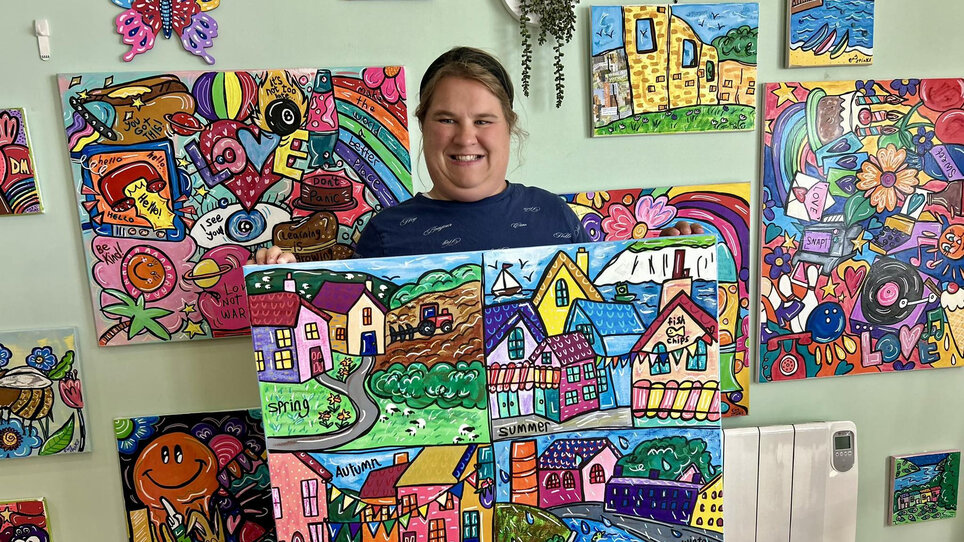
Emy is proof that misconceptions are usually very wrong. Her artwork appeals to people all over the world, without the need for words.
Emy and her one-to-one support worker, India
– on how Emy’s art has built connection and communication.
Content note: Emy’s story contains distressing and offensive comments from medical professionals in the first question.
When did Emy’s family first know or start to think that she was autistic?
Emy’s mum first noticed her behaviour change around 18 months old. She had been making eye contact, using words like 'Mumma' and 'Dadda' and then these skills changed quite quickly. Emy has a brother who is only 14 months older, so her parents were able to see the difference in milestones. Emy’s mum also had experience working with autistic adults, so she recognised some familiar behaviours. She requested an autism diagnosis when Emy was two and a half. This was a very distressing time, with very little information, guidance or knowledge.
Emy’s mum talked to me about her experience at the time and Emy’s journey until I started working with her:
“I took Emy to our local doctor initially and aired my fears, to which I was told: ‘She cannot be autistic,’ as she waved to him involuntarily. Shockingly, the doctor also said: ‘Cancer would be a preferable option as at least there's a chance to cure that.’
“We then had a home visit from a health carer, who said: ‘Put her in residential immediately and forget about her; you're young, you can always have another.’
“You can only imagine how devastating these comments were. However, these comments made me even more determined to ensure our beautiful, funny, precious daughter would have an amazing life – no matter what!
“I contacted the National Autistic Society, and we were directed to a local diagnostic specialist. This appointment confirmed that Emy was autistic and would probably never speak and need 24-hour care.
“I made a plan and looked into every therapy for early intervention. We also attended the EarlyBird course run by the National Autistic Society, which was enormously beneficial as both parents were encouraged to attend.
“Following these years, Emy attended a very progressive primary education with one-to-one support and then two provisions for children with additional needs. These were very difficult years for Emy, but she had started drawing and loved her art.
“After sixth form, we joined an academy and Emy worked with other young people in a studio setting, but again she found this difficult and would search out places of quiet to create her work.
“Enter India, who became her one-to-one support worker. The collaboration and communication between India and Emy was instantaneous and seemed to be the missing thread that Emy needed to progress and find unmatched happiness and joy in her work. We cannot believe all she has achieved; we could not be prouder or more grateful.”
India, what was the diagnosis process like for Emy and her family? What did it mean when she got her diagnosis?
For Emy’s parents, the diagnosis process was intense and stressful, but this was more than 27 years ago. To get the diagnosis, even though very misunderstood at the time, gave her parents a place to start to understand their child’s struggles and needs.
Over the years, Emy’s parents have remained her advocates, always pushing for more acceptance of autism. Autism is but one part of Emy; it is how her brain works, and she has so much to show the world.
No matter what society or anyone assumes, there is so much more to someone than just their diagnosis. A diagnosis is a starting point to find others who share similar experiences and express themselves fully.
“Seeing people interact with her artwork really showed how much Emy’s art is not just about the places she’s visited but how she communicates.”
Emy has been creating beautiful art that she exhibits in her local community. What does this creativity and community involvement mean for Emy?
Emy has had a passion for creating artwork since she was small. Her artwork has developed as she’s grown up. After lockdown, Emy created lots of artwork that reflected the places she was once again able to visit. We decided to put on an exhibition in Selby Abbey, which was Emy’s first solo exhibition.
Seeing people interact with her artwork really showed how much Emy’s art is not just about the places she’s visited but how she communicates. Now, when she takes her artwork to local places who’ve requested to display her work, you can clearly see how proud Emy is.
People are drawn to her artwork, and she watches as people really take time to look and interact with her artwork. Emy will often then photograph where her art ends up, which brings her immense joy. Emy will even point to her artwork and name places and things she sees. It’s so nice when those admiring her artwork also join in. Though Emy’s verbal vocabulary is limited, she’s now able to point at a picture and say ‘Seaside, Scarborough’ and communicate her artwork’s features.
You and Emy also volunteer and run art sessions at local care homes. What do you and Emy enjoy most about these sessions, and how did they come about?
I began contacting local care homes a few years back to ask if they had space and would like to host an exhibition. Before this, many of Emy’s pieces were sent off to galleries, often far away, meaning Emy never got to see her art displayed in person.
Many local care homes were delighted and so we took several pieces, including 21 pieces to one in Selby. We built up a rapport with the care home staff and residents, as the art was for sale and as each piece sold, we’d take a new one. They asked if we’d be interested in bringing some of Emy’s colouring for the residents. On visits, Emy had often taken blank colour drawings as a gift for the residents. We agreed and went along with art activities that Emy chose. We’ve painted bird boxes for a care home garden, made easter cards, Halloween crafts and Christmas bunting and cards.
For Emy, she enjoys choosing things to take to the care home and creating pictures for them to colour. It’s also a chance to get out and meet new people. Emy can struggle with loud, unexpected environments, but amazingly if she has a task to do, she seems to be far less affected.
Usually, the care homes are pretty relaxed, and the residents are always excited to see Emy. They’ll put music on for Emy, and she hands out the activities, makes sure everyone has enough pens and sits between the residents and gets on with the crafts. Emy has never been distressed on a visit, something that I thought may happen initially. We take it one visit at a time, but Emy always looks forward to her next visit.
Emy takes it all in her stride and you can see the pride she takes in getting everyone involved. We’ve had times where residents are unsure if they want to take part; after seeing Emy busy creating colourful art, they want to join in too. Emy always asks when the next trip to the care homes will be, she lovingly calls it the ‘granny festival’.
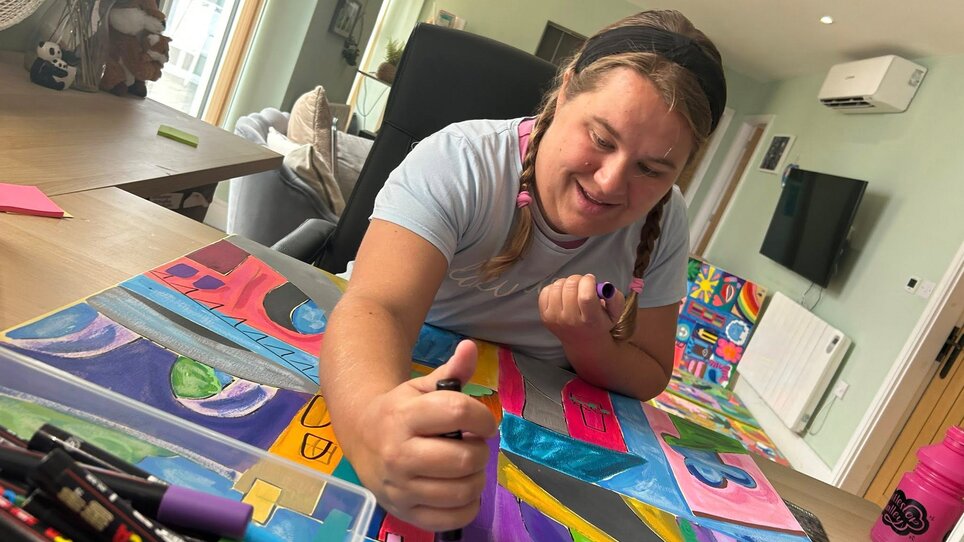
“It was best to see what things Emy found of interest and let her take charge. I was there to help her or get her things. I listened to Emy and never tried to ‘teach’ her.”
Art can be a powerful communication tool for autistic people who speak few or no words. Have you noticed a difference in Emy’s communication and self-expression through her art?
Over the last three or four years, Emy’s communication has come on leaps and bounds. Her confidence is the most staggering thing. Before, Emy had a voice, but she almost kept this to herself or to the few that she knew very well. In social settings, she would be quiet or only repeat phrases from cartoons. Since we’ve taken part in more community projects, and as we’re out and about all the time, everyone knows Emy.
Her art gives her something to talk about, and her confidence has grown alongside this. We often have customers and visitors come to our studio, and Emy proudly shows them her artwork and poses for photos. She’s able to go along her gallery wall and point out her artwork. A few years back, Emy would really struggle with someone unknown in her space. Her art has helped her in so many ways.
Since supporting Emy, have there been things you’ve learned about autism that you didn’t know before?
When I first met Emy, she was attending a provision for adults after they left school. She was just 21, as was I. I admired her artwork, which featured a lot of cartoons, and because we’d grown up watching the same TV shows and enjoying the same things, we bonded.
I learned so much from supporting Emy, mainly that the best approach is to let Emy lead and show you what she’d like to do. Other staff had tried to direct Emy to create artwork that had no appeal to her, and she was frustrated with that approach and just drew what she felt safe doing. I quickly realised that it was best to see what things Emy found of interest and let her take charge. I was there to help her or get her things. I listened to Emy and never tried to ‘teach’ her.
After lockdown, we started working exclusively together. We both learned so much about one another. We’re very similar in many ways; we like music on when we’re working and a calm environment with structure. I’ve learned that autism can sometimes mask how someone is really feeling. To others, they may just hear repeated phrases, but I know and understand what each of Emy’s quotes mean and how they reflect her mood and needs. I’ve learned to never judge someone on any ability and let them show you what they can do. I feel so privileged that Emy has let me into her world and shown me how she sees the world. I find myself noticing and appreciating the small things and just taking time to absorb the world.
“Emy sees the world in so much colour and beauty, and others can relate to this.”
What is one thing you and Emy would like more people to understand about autism?
Through Emy’s art, we make people question their misconceptions of anyone who is neurodivergent. We’ve had many people who are shocked Emy has created the artwork herself. I wish people would understand that anyone is capable of anything with the correct support and in an environment they feel safe in. I also wish people would understand that communication and trust are key. In a world that can often be overwhelming and loud, just taking time out, finding peace and listening to their needs can make such a difference. Learning the vocabulary they use, no matter how much they speak, and being able to say that back can create trust.
Emy is an autism advocate. What does autism acceptance mean to her?
To Emy, I would say it means to be treated like anyone else and given the same opportunities. It means no-one ever speaks down to her, uses a baby voice or questions her abilities. Emy can sense when someone does this to her, and she will almost roll her eyes to me now.
Advocating to us is all about educating people; showing people the world through Emy’s eyes, rather than trying to force Emy to fit into society’s view of the world. Emy sees the world in so much colour and beauty, and others can relate to this. She has a large social media presence now, and I run the page, sharing her art and journey on her behalf. This allows us to share the message of autism advocacy and acceptance globally.
Emy really has created such a positive impact through her artwork and has had so many achievements that the doctors diagnosing her over 27 years ago could never have even dreamed of. Emy is proof that misconceptions are usually very wrong. Her artwork appeals to people all over the world, without the need for words.