


"No, Not That One. I Need Satellite View": Understanding autism alongside trauma through lived experience
Published on 02 November 2026
Author: Sarah Sluman
Sarah Sluman is an accredited counsellor (MNCPS), CYP mentor and former nurse. Through her private practice, The Hope Cabin and her lived experience as a late-diagnosed autistic person, she brings together professional knowledge and personal insight. She is particularly interested in the intersection of autism and trauma, including how autistic people can go unrecognised for years when their experiences are understood through other lenses. Through The Hope Cabin, she runs an experience-led Facebook group called 'Late Diagnosed Autism, ADHD, AuDHD Support', aiming to create online and in-person spaces where people can connect and share without judgement. Her work is grounded in curiosity, reflection and looking beyond initial assumptions to better understand people as individuals.
How do we understand experiences when autism and trauma coexist?
In this reflective article, I explore being diagnosed as autistic at 40, partway through my counselling training, having previously understood many aspects of my life through the lens of trauma.
Using the metaphor of map layers, I reflect on what happened when I discovered that trauma did not fully explain my lifelong experiences, and what this taught me about curiosity, assumptions and continuing professional learning.
Introduction
When studying neurodivergence on my counselling course, I encountered a simple diagram: two circles, one labelled Autism and one Trauma. Where they overlapped were experiences that could occur in either, or potentially both.
It was a simple reminder of a fundamental principle of person-centred counselling: don't assume.
There was something I didn't know when I first looked at that diagram.
I was autistic.
I was diagnosed partway through my counselling training, at 40. While learning about neurodivergence professionally, I was also beginning to understand myself through an autistic lens.
Before this, I had understood many of my difficulties through diagnoses such as anxiety and depression. I remember looking up the word ‘endogenous’ and understanding it to mean something that came ‘from within’ or ‘having no cause’. At the time, that explanation made sense to me.
Later, trauma provided another framework. I remember telling my counsellor that I believed I best understood my challenges as C-PTSD. It wasn't necessarily wrong, and it gave me a framework that helped me understand myself and move forward.
Looking back, I can see how easily an explanation that makes sense can also become the place where we stop looking.
Further exploration has since helped me understand that some of what I had experienced as trauma may also have been connected to being autistic, and that the two had sometimes become difficult to distinguish.
Layers
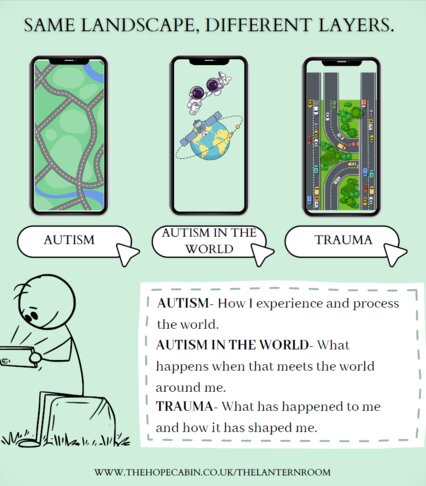
Google Maps allows us to change the view: satellite, terrain, traffic or other layers of information. The landscape hasn't changed, but each layer shows us something different.
That is the closest metaphor I have found for my experience.
Trauma didn't disappear when I selected another view. The things that had happened to me remained true. But suddenly, I could see features of the landscape that hadn't made sense on the first map.
I began to recognise patterns that had been present throughout my life, bringing new awareness to my experiences.
As a child, I was constantly trying to catch up socially: listening to tone, watching people, learning expressions and trying to understand meanings that hadn't been said directly.
When I was little, a family member once said: “See you later.”
I understood those words literally. When I was told they weren't coming back, I was distressed and thought: ‘But you didn't mean what you said!’
It wasn't a traumatic event. My family member was simply saying goodbye.
But it was one small example of something I had experienced repeatedly: trying to understand a world where meaning wasn't always as explicit as I needed it to be.
Two things had existed together.
I had experienced trauma. And I was autistic.
Looking at the whole landscape
This led me to think differently about how we explore autism alongside childhood trauma.
The overlapping-circle diagram is helpful, but I wonder whether we also need to professionally consider another layer: the experiences that can arise from being autistic in a world that does not always understand or accommodate autistic ways of experiencing and processing.
Repeated misunderstanding, sensory overwhelm, social confusion and exclusion can all become part of that landscape, and for some people these may themselves be traumatic or contribute to trauma.
But perhaps the most useful therapeutic support we can offer is creating space to ‘open up’ the other layers of the map for our clients.
Clients may arrive with a diagnosis, or a description of what they are experiencing, and we can meet it with curiosity.
Though our role is not to diagnose or determine what a client’s experience means, it can be helpful to reflect on what explanations we tend to reach when a client describes distress.
We might ask the client questions like:
“What is happening for you when this occurs?”
“Are there any sensory experiences that affect you?”
Emotion cards can be particularly supportive for clients who may find identifying and naming emotions or experiences more difficult. A timeline can also help clients reflect on their journey through different layers.
“Has this always been part of your experience, or does it feel more recent?”
For me, the answer to the last question would have been ‘always’.
I wonder whether that one question might have opened another layer of awareness for me earlier.
Conclusion
Discovering this has made me more conscious of my responsibility as a counsellor.
My own training was a starting point, not an ending. The more I understand about autism, trauma and their overlap, the more committed I am to continuing to seek current, evidence-informed understanding.
I believe remaining curious is part of that responsibility.
It has also changed how I understand some of my own strengths.
Recognising tone, implicit meanings and social cues did not always come naturally to me. I had to consciously learn to notice things that others seemed to absorb without thinking about them.
There is a paradox in that.
Because these things didn't come naturally, I learned to notice them carefully.
In counselling, that attentiveness has found a different purpose.
I can use something I have spent a lifetime learning to notice to remain curious about another person's experience and, most importantly, without assuming.
Perhaps skills developed through necessity can, in the right environment, become strengths.
Article sources and references
Quinton, A. M. G., Ali, D., Danese, A., Happé, F. and Rumball, F. (2024). The Assessment and Treatment of Post-traumatic Stress Disorder in Autistic People: A Systematic Review. Review Journal of Autism and Developmental Disorders. Available at: The Assessment and Treatment of Post-traumatic Stress Disorder in Autistic People: A Systematic Review
Sarr, R., Spain, D., Quinton, A. M. G., et al. (2024). Differential diagnosis of autism, attachment disorders, complex post-traumatic stress disorder and emotionally unstable personality disorder: A Delphi study. British Journal of Psychology. Available at: bpspsychub.onlinelibrary.wiley.com/doi/10.1111/bjop.12731